
Open the package and confirm you have everything below before you start the install.
Four things to know before you start. The case stays sealed once installed — everything is accessed via the wire harness.
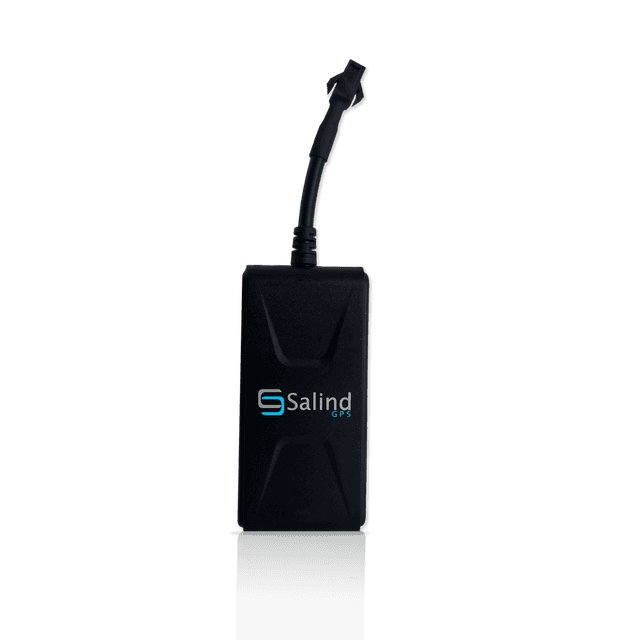
- Wire harness exitRed, black, and (on the -I variant) white wires leave the case from one end.
- LED signals (2)Orange (network), blue (GPS). Visible through the case.
- Sealed enclosureNo flap, no switch. Power on/off is controlled by the vehicle's wiring.
- Device ID labelPrinted on the back of the case. Note it down before you mount the tracker.
The device ID is printed on the back of the tracker.
Four steps. A clean install takes about half an hour with the engine off and the vehicle battery disconnected. If you're not comfortable with vehicle wiring, any workshop will do it in under 30 minutes.
Pick a hidden location.
Behind the dashboard, under a seat, or inside the trunk lining — anywhere the LEDs stay out of sight and the case is shielded from rain and splash.
Connect red to constant +12 V or +24 V.
The red wire must reach a live circuit that stays powered even when the ignition is off. This is what keeps the tracker reporting while the vehicle is parked.
Connect black to ground.
Any bare-metal chassis point or the negative terminal of the vehicle battery.
Connect white to ignition (S-014-I only).
On the variant with ignition input, the white wire detects when the ignition is on. Skip this step if you have the Standard variant (S-014).
You need to register and activate the device online before the tracker can report its location.
- Open start.finder-portal.com in a browser.
- Follow the on-screen prompts to pick a subscription plan and register the device using its ID.
- Download the FINDER Portal app on iOS or Android.
The Salind 01 has no on/off switch. Once the wires are connected and the vehicle battery is back on, the tracker powers up automatically. Turn the ignition on to confirm both LEDs come alive within a minute.
Once the device has activated and reported its first position, you can track it from your phone, tablet, or computer.
The app looks the same on every device. Along the bottom of every screen sits the navigation bar — reading left to right, these are the five areas you'll use most.
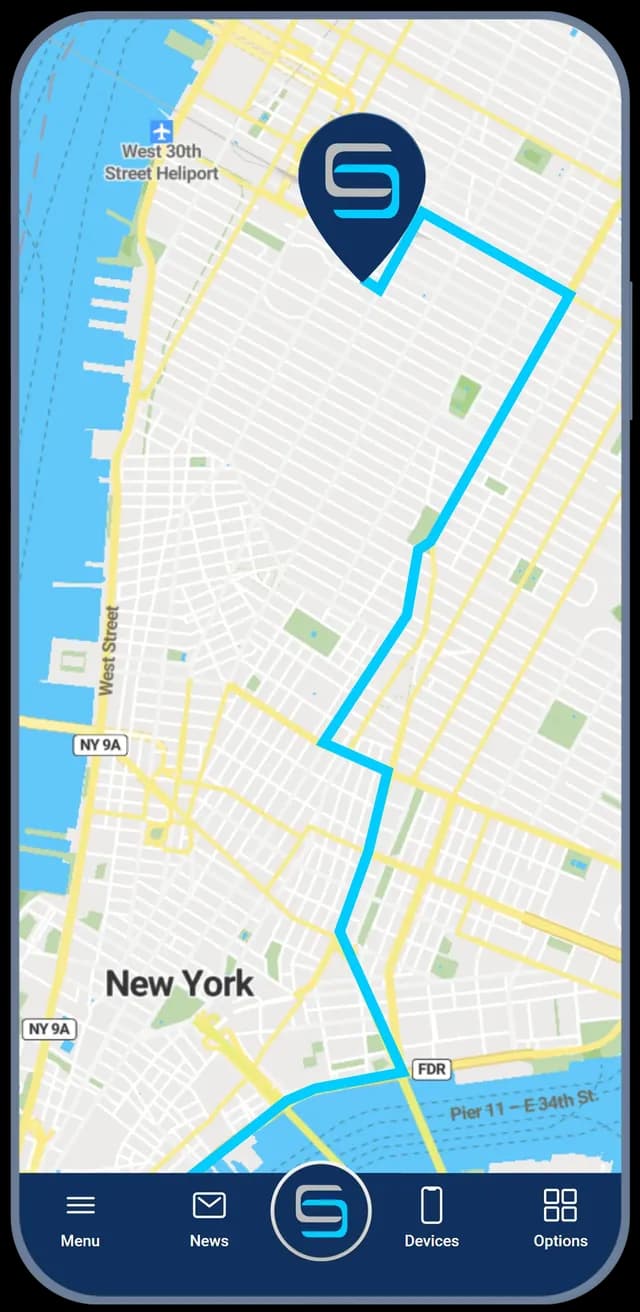
- MenuStatistics, device settings and alarms.
- NewsYour latest activity, unread notifications and timeline.
- Live mapThe middle button jumps back to the live tracking view.
- DevicesAll your trackers, with alarm settings and route history.
- OptionsMap view options.
Because the Salind 01 draws power directly from the vehicle, it reports its position continuously — there is no battery-saving standby mode. By default the tracker sends an update every 30 seconds while the vehicle is in motion.
If the vehicle's power is cut — wires tampered with, fuse pulled, or the vehicle battery disconnected — a built-in backup battery keeps the device online so it can fire a Power-cut alert and keep reporting its position until you recover the vehicle.
Each LED reports the health of one subsystem. The Salind 01 has no battery LED — power state is controlled by the vehicle.
- On solidCellular signal available
- FlashingNo signal
- OffTracker has no power
- On solidGPS signal available
- FlashingNo GPS signal
- OffTracker has no power
Configure each alarm inside the FINDER Portal. They run independently — turn on as many as you need.
Movement / Vibration alert
Get notified the moment the tracker is moved or shaken while parked.
Geofence alert
Get notified when the tracker leaves (or enters) a custom area you draw on the map.
Speed alert
Get notified when the tracker exceeds a speed limit you set in the portal.
Power-cut alert
Get notified the moment main power to the tracker is interrupted — wires tampered with, fuse pulled, or the vehicle battery disconnected.
Electronic logbook
Automatic trip log of every journey — start, end, route, distance, duration. Exportable from the portal.
All alerts are configured inside the FINDER Portal. Once enabled, notifications fire to the app and to your email.
Pulled from the user manual and technical sheet. Reference values, not marketing claims.
| Weight | 53 g (~1.9 oz) |
|---|---|
| Dimensions | 80 × 38 × 17 mm (3.1 × 1.5 × 0.7 inch) |
| Power input | 9–75 V DC (12 V / 24 V vehicle electrics) |
| Backup battery | Built-in, runtime depends on cellular signal quality |
| Active tracking | Continuous — no standby mode |
| Cold start | 3–5 min |
| In-operation start | 1–10 sec |
| GPS chip | AT6558R |
| GPS accuracy | approx. 5–10 m |
| GPS reception sensitivity | −162 dBm |
| Operating temperature | −20 °C to +75 °C (−4 °F to +167 °F) |
| Storage temperature | −30 °C to +80 °C (−22 °F to +176 °F) |
| Humidity | 10 % to 85 % |
| Water protection | Splash proof — IP64 (per User Manual) |
| SIM | Pre-installed M2M, non-replaceable |
| Coverage | 100+ countries |
- Disconnect the vehicle battery before wiring. Always tap into existing fuse-protected circuits.
- If your vehicle is under manufacturer warranty, check whether aftermarket wiring affects coverage. A workshop install with a documented invoice is usually the safer route.
- Mount the tracker where it stays dry. The case is splash-proof, not waterproof — do not install in an engine bay exposed to rain.
- Keep clear of airbag wiring and any safety-critical harness.
- Don't open the case. The backup battery is not user-replaceable. Contact support if it needs service.
- For full safety, electromagnetic compatibility, battery disposal, and WEEE disposal information, see the PDF.
Visit our Support Page — available 24/7.